Monday, March 16, 2009

World's fastest hybrid car?

If you like very cool looking sports cars that really deliver in speed, like I do, but you don't want to pay the price of pathetic gas mileage, like I do - then you'll love this.

Italdesign, a renowned sportscar designer, unveiled the Namir at the 79th Geneva Motor Show, a vehicle that they claim will be the fastest hybrid car in the world. Boasting a scorching top speed of 187mph with 370hp, and able to travel over 1,200 miles without a refill or a charge, this just might be the answer to your speed racing fuel-efficient dreams.

The Namir hybrid concept was designed with the help of Frazer-Nash. Pictures of the concept car have been leaking out for weeks now.

The press release reveals that the Namir hybrid will have a lithium ion battery pack, with overall power of 270 kW, equivalent to 370 hp. They claim the car will get a fuel efficiency of about 92 miles to the gallon. And with the car’s 50 liter gas tank, the car can travel up to 2,000 km without a refill or a charge.

The top speed of the Namir is 187 mph. Compare that to the last year’s hot hybrid sports car, the Fisker Karma, whose top speed is only 125 mph, or the Tesla Roadster (my personal favorite) whose top speed is also electronically limited to 125 mph. Looks like the Karma and the Tesla will be crawling along in comparison.

No word on cost of the vehicle, or if it will be available in the US, but by the looks and sound of the concept, this is certainly set to be the new hot car.

I love the innovative windshield design and the tough look of the exterior of this car.

My only question is how do you see out the rear window?

Saturday, February 28, 2009

Why is Mesquite a Sustainable Choice?

Mesquite is a sustainable wood because it is actually a bush, not a tree. Attempts to cut, shred, remove and even burn does not kill mesquite root systems and results in mesquite growing back stronger and thicker. Farmers and ranchers have tried to eradicate mesquite for hundreds of years resulting in them growing back stronger and expanding their area of growth as animals and cattle eat the seed pods and distribute the seeds. Based on current usage of mesquite and eradication efforts the supply in Texas alone can last for thousands of years without need to plant additional mesquite.

The beautiful reddish-brown wood is also extremely durable and the hardness is better than oak, maple or mahogany. It is more tolerant of moisture than many woods, which makes its use in areas like kitchens a possibility. One disadvantage is that large and longer board lengths are difficult to find and substantially raise the costs. However, shorter planks or end-grain blocks can be quite unique and attractive.
This mountain vacation home in Colorado features a mesquite countertop and cabinets in the bar.


Friday, January 30, 2009

Magnificent Flooring with a Story to Tell

One of my favorite eco-friendly products is reclaimed wood flooring, and a fantastic source here in Scottsdale is Vintage Hardwoods. They offer a wide variety of wood species sourced from the US and Australia. Reclaimed wood already has that beautiful patina of wear and a story to tell - something we often try to achieve through artificial aging processes, with sometimes less than fabulous results.


By using the wood from old barns, sheds and other structures which are going to be torn down, we save new trees from being cut down, avoid sending smoke and ash into the air (because often these buildings are burned rather than torn apart), and are able to experience some incredibly beautiful woods that may not even be around anymore.

Vintage Hardwoods resources, gathers and re-mills all their own wood. They specialize in longer planks which, while more difficult to remove from the old structures they were originally a part of, create a longer lasting and more beautiful floor. Often their wood comes from smaller structures, as well - those that many people don't want to hassle with disassembling and transporting.
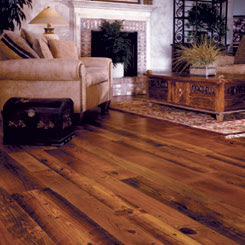
Vintage Hardwoods uses water based stains and low VOC glues to finish and install the planks in your rooms. Each installation is provided a plaque that identifies the wood species and where it was sourced from, as well as the approximate date of its first use.

By its nature, reclaimed wood is always unique and available in limited quantities. Some of my favorites are shown below.


Reclaimed Australian Sheep Wood

We call it "sheep wood" because it is authentic floor planking removed from original sheep shearing facilities and wool sheds in Western Australia. The white gum species were used because their extreme hardness and durability were able to withstand the constant traffic of the sheep.
We locate this wood, import it and then restore it in our mill. We preserve it's original character while revealing a new beautiful complexion. The result is a luxurious floor reminiscent of the frontier days of the outback.
Woods from these eucalyptus families are beautiful and elegant. They are characterized by a smooth, creamy grain and original nail holes darkened by decomposed nails. The natural color is a light reddish brown with hints of chocolate.

Reclaimed Australian Spotted Gum

Historically, spotted gum was used in Australia for construction piles and shipbuilding. Its long fibers give it an excellent "power to weight" ratio and high resilience. The original timbers came from Australia's east coast in a section from the far south to Queensland. Spotted gum has varied grain patterns and colors ranging from light mocha to pale blond with peach undertones.


Reclaimed Vintage Oak

For hundreds of years oak has been used to build barns and warehouses. Oak is a popular choice for reclaimed flooring because of its very fine grain patterns, interesting knots, and nail holes with mineral stains left by decomposed nails. Other characteristics include saw marks, hairline cracks, and occasional worm holes. Reclaimed oak has beautiful nut-like tones ranging from a deep mocha to light cream.


Reclaimed Vintage Heart Pine

With its strength and durability, heart pine was used extensively in shipbuilding, as well as for houses, barns, factories and warehouses. The supply of this wood is limited because the old-growth yellow pine trees were all cut down by the early 1930s. This beautiful reclaimed flooring is characterized by its varied grain patterns and unique colors of light gold, shades of red, orange, brown, and dark honey. The dramatic coloration is created by an oxidation process; the planks change color as they are exposed to season after season of heat, cold, snow and rain. The planks expand and contract as they go through the seasons, becoming harder as the colors deepen. The sapwood begins to crystallize and deepen in color. Other characteristics of reclaimed heart pine include knots, nail holes, mineral stains and occasional saw marks.

Reclaimed Vintage Sycamore

The hearty sycamore tree has the largest leaf of any tree native to North America. It was used primarily for barns built in the mid 1800's. The sapwood of sycamore is white to light yellow, while the heartwood is light to medium brown. This beautiful wood has a fine, close texture with an interlocking grain. Reclaimed sycamore is characterized by its light, creamy color, dark knots, nail holes with mineral stains and occasional saw marks.

Thursday, January 29, 2009

Green fabrics come in all colors

Brentano Fabrics has added a new label to their line which features exclusive eco-friendly textiles in a variety of styles, and materials. Their commitment to a green awareness while still designing with beauty and performance in mind led to the creation of Brentano Green, which includes both woven textiles and faux leathers.

The Brentano Green labeled materials are qualified with the following criteria:
Raw Materials must have either biodegradable or recycled content
Process evaluation of the dying and weaving as well as other environmental aspects in manufacturing the textiles
Facility & Social Responsibility accounting for working conditions, public health and green programs

The eco-fabrics are made from bamboo, eco-intelligent polyester, eco-wool, 100% post consumer recycled polyester and biodegradable polyurethane. In 1993, Brentano was searching for an alternative to environmentally harmful leather and vinyl textiles. After learning about polyurethane, they made the decision not to produce either leather or vinyl products, instead developing beautiful and environmentally friendly faux leathers.


Bamboo is 100% biodegradable and a rapidly renewable resource. It has anti-bacterial and anti-fungal properties. Bamboo also has the ability to absorb carbon dioxide and produces a large amount of oxygen as it grows.

Brentano's Eco-intelligent Polyester is MBDC Cradle to Cradle Gold rated and part of a closed loop system designed to be upcycled (after use, it can be recovered and remanufactured safely and effectively). It is manufactured using 100% hydro-power.

Eco-wool is a naturally environmentally friendly fiber that requires less water and fewer pesticides than linen or cotton. The fibers have almost no toxic residues and it is compliant with EU Eco-label standards, Environmental Choice New Zealand certified and the mill is ranked Enviro-Mark Silver.

100% Post consumer Recycled Polyester if rated MBDC Cradle to Cradle Silver. Using post consumer polyester fibers preserves virgin oil, reducing use of this natural resource. The fabric is recyclable and the dyestuffs contain no harmful chemicals or heavy metals.


Faux Leather is made from biodegradable polyurethane, it is naturally soft and flexible and does not require plasticizers often used to soften vinyl or heavy metals used to tan leather.

Brentano Fabrics are available through your designer.

Thursday, January 22, 2009

Celebrating 40 years with new Eco-Friendly Collections


Maya Romanoff, the artistic creator of the luxury wallcovering line by the same name utilizes both ancient and new production techniques. He has created some of the most innovative and exotic surfacing materials available -everything from glass bead and seashell encrusted papers to vinyls and inlaid wood veneers.

The design philosophy of the Maya Romanoff company, based in Chigaco, is simple: “It has to be beautiful”. While everything they design is governed by their collective definition of beautiful, Maya remains the ultimate decision maker, guiding color choices, and pattern repeats based on his feeling for what is most pleasing to the eye. The company also likes to support American jobs - more than 50% of Maya Romanoff’s wall coverings and surfacing materials are made in their Chicago studio by long-term employees. “Instead of exporting jobs to India and Asia, we export wallpaper,” says Laura.


Their products are consistently intriguing and increasingly eco-friendly. Existing collections include: the Mother of Pearl wallcovering made from a thin layer of Capiz sea shells; Bedazzled, a wallcovering featuring glass beads; and True Metals, flexible tiles of brass, copper or aluminum.

“What all these have in common is that they are flexible and made of natural materials. We strip away the unnecessary finishes so the material itself can be appreciated. The glass beads are right there on the surface; nothing covers our woods; and there’s only a thin layer of varnish on the seashells,” explains Laura Romanoff, daughter of the firm's founder.


In honor of their 40th Anniversary this year, they’ll be releasing the Meditations collection-an entirely green product made of Tibetan prayer papers and produced without electricity, and putting a more contemporary spin on the existing collections.


A very exciting new addition to the line is Sunburst, a wood veneer made of Paulownia, a fig tree that is flexible and fast renewing. Sunburst is part of the Ajiro collection, a product which recently received Interior Design Magazine’s Best of Year award. The veneer’s extraordinary hand-inlaid pattern and sustainable aspects make it an ideal product for today's eco-conscious luxury homes.

The Maya Romanoff company has never been a slave to design trends, but instead creates products with the timeless appeal of natural materials. With this focus, Maya Romanoff will certainly be celebrating many more anniversaries in the years ahead.

Maya Romanoff wallcoverings are available exclusively through the Trade - contact your designer for samples, pricing and ordering.

Wednesday, January 21, 2009

Perfect Harmony

A Montana home resonates with the surrounding land as much as it does with the owner’s heart


This beautiful sustainable home is in harmony with its surroundings due to some careful thought and planning by the homeowner and her designer. She liked the look and feel of NY lofts but also wanted something that fit in with the farms that dot the landscape around her home.

The result is that her place looks like it has been part of the landscape for ages. The designers’ challenge wasn’t limited to a farmhouse exterior look- the homeowner asked that the interior have the feeling of a New York City loft.
"The two ideas may have seemed totally incongruous to some, but these design pros quickly found common ground. “Some real creativity came out of thinking about how to marry the two concepts,” says [the designer]. “[The owner] wanted to use as many sustainable materials as possible, and I thought about the post-and-beam aspect of city lofts; I used to live in New York, so I had a pretty immediate reference to that. We thought if we could have the house come out of the idea of a barn structure, which is also typically post-and-beam, that [construction technique] could be our common departure point,” she explains. “While it would look like an outbuilding, it would only reference one, not replicate one.”


- for more see the article in Mountain Living Magazine, November/December 2008 issue

Tuesday, January 20, 2009

Amazing Glass (Tiles)

Just found these 100% recycled glass tiles from Bedrock Industries - they use only post-industrial and post-consumer glass and NO added oxides or colorants. Each tile is handmade, creating a distinctive appearance and wonderful color variations.

These are available through designers and tile showrooms nationwide. People have used them in many creative and unique ways - I love the idea of using them on the porch transom to create wonderful light play outside.


The tiles are available in many sizes, shapes, designs and colors - there is sure to be one that fits your style whether that is traditional or modern.
You can bet I will be specifying them somewhere in upcoming projects!